
The website is for my personal projects, and this is… something like that. I’ve been training at Zombie Muay Thai in Manhattan for about two years, and in February this year I fought an exhibition Muay Thai match against a guy from another gym. We fought three 2-minute rounds of exhibition Muay Thai—punches, kicks, knees, and stand-up clinching, no winner declared. I’d say the outcome was pretty even.
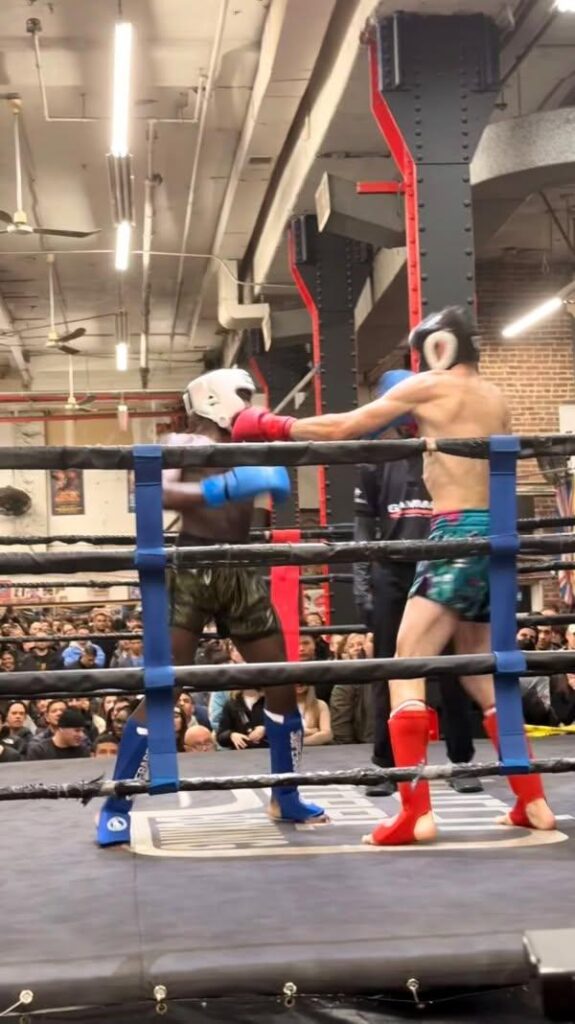
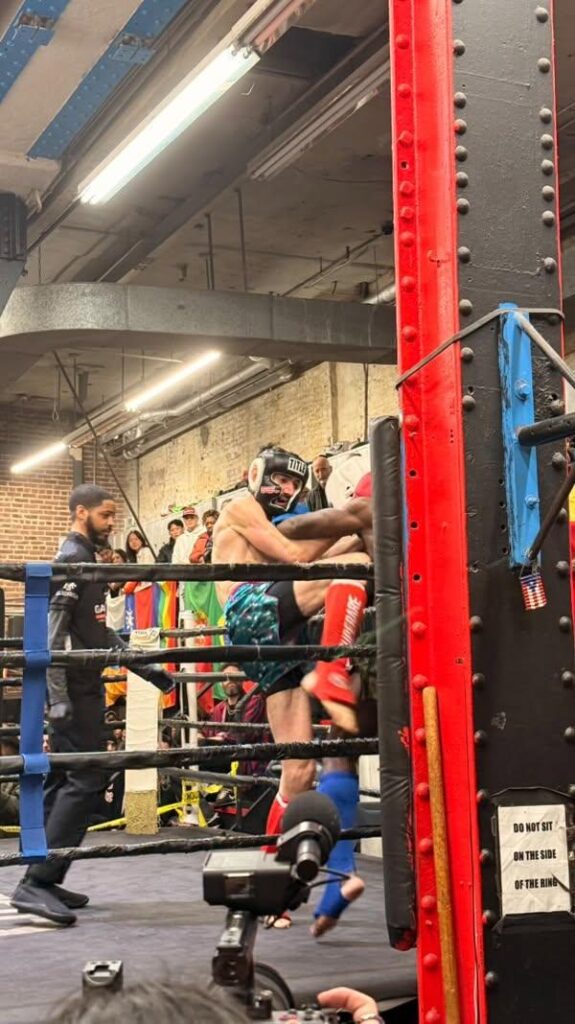
I wasn’t sure what to write for this; I’ll just list the things I learned or noticed along the way:
- It’s amazing what you can get used to, lifestyle-wise, if you consciously accept all the tradeoffs beforehand. For six weeks of “fight camp” I ate healthy every day, didn’t drink, and spent about 20 hours per week on training (between gym training sessions and strength/mobility on my own). I didn’t go out very much, didn’t start any big projects, didn’t travel. And it was fine! I didn’t feel FOMO about whatever my friends were up to, and I didn’t feel depressed about how routine it all was. FOMO comes up when that part of you thinks it can convince you to break. If your commitment is non-negotiable, your subconscious won’t try to negotiate.
- Losing weight was disappointingly easy. I thought it would be hard because 1) I’m 32 and my metabolism is surely slowing down now, and 2) I was already pretty lean at 6’5″ 195lbs, not a lot of fat to spare to get down to the 180lb fight weight. But it wasn’t hard. In the past I’ve tracked my calories to gain weight, so I just did that but with a calorie deficit. I’d weigh myself every morning, and every morning it’d be what I expected. It was disappointing because… that’s it? This horrible undertaking that’s just impossible for every adult in America to do? Enter your food into MyFitnessPal, make the numbers be small, and commit to feeling a bit hungry each day—this is your impossible ordeal, people? My coach told me to ease off and eat more about halfway through, because it was working too well.
- Body fat percentage is everything, as far as looks go. As I was losing weight, people at the gym were complimenting me “looking big,” and it’s simply because you could see my muscles better as I lost fat. I thought that was funny.
- I had a little epiphany about effort and success. Here’s how it came about. As I committed a lot of time and attention to this goal, I noticed I have a tendency to always keep a little in reserve. And then later, if the fight didn’t go my way, I could tell myself that I prepared “reasonably hard, but [some reason why I lost].” It’s the same mistake as the one in epistemology: trying to be “reasonable” instead of trying to be correct. “Reasonable” is like a consolation prize: you can be wrong and reasonable. You can prepare “a reasonable amount” and at the same time “not enough.” To let go of the consolation prize, you have to accept the possibility of losing—fully losing, not “I lost but [reasonable mistake I made]” or “I lost because [factor that I couldn’t be expected to anticipate].” Also, there’s a special appeal to “I lost because [reason], which I did anticipate.” To a nerd like me, losing in a way you predicted kind of feels like a win, because at least your mind fully comprehends reality. This is bad! Anyway, it’s actually so easy to interpret losses like this, coming up with some angle, some excuse that explains away your loss; I don’t know if I’ve ever fully accepted a loss in my life. So, I consciously decided to avoid that this time. You can’t commit fully while at the same time leaving a safety net for your ego.
- This was probably necessary to improve my skill. Another fighter at my gym said the same. We hit plateaus in our regular training, because we’re fully conditioned to the intensity of the classes, and we settle into our comfortable strategies in sparring. Preparing for the fight gave me a reason to train extra hard, extra frequently, and spar a bit harder and with more focus. And it was great to watch myself improve.
- I was nervous on fight day, of course, but my coaches were good at keeping the vibes good. The six of us, three fighters and three coaches, really had a good time with it. It was all positive adrenaline.
- It’s exhausting to defend against powerful strikes. That’s a different kind of conditioning from what I was used to. During my fight camp, we would train every night of the week, 2-3 hours, and I’d still have enough energy to feel fine on the brisk walk home. But in the six minutes of this fight I was exhausted. It’s all the tensing and rebalancing you have to do when you defend against full-power strikes (something we hadn’t done much of in sparring, plus I’m in a high weight class i.e. more power). That felt like the weak point in my game.
- The only pain I felt was the systemic pain of exhaustion, just like what you’d feel from sprinting too fast for too long. Adrenaline completely masked the pain of getting hit.
I’d do it again, if I can find another block of time like that in my schedule. It was a really good experience overall.
Some clips on Instagram

Great observations!
On dieting: You seem to have a natural talent at it. The reason why many people find it hard is they experience a lot more hunger because of how their body is tuned, or are in crab-buckety social settings where obesity is normalized, or have an eating disorder / food addiction. So, for example, I know this one nutritionist that came from a poor background and was just raised ignorant of nutrition, then learned about it in high school and lost 100 lbs easily. I’ve also known people who were so wound up with anxiety already that if they got in a deficit they couldn’t really sleep properly because they were so discomfort-intolerant. I think there are both genetic and lifestyle factors that can contribute to that kind of hunger intolerance. I’ve also seen that sort of thing co-occur with emotional eating / food addiction. Overeating also has a momentum, so regardless of heritable factors, eating too much mistunes your hunger system. So I think you are talented both in terms of your hunger response and your ability to stick with plans and not give in to peer pressure / select friends that are actually friends and not threatened by your dieting. Many are not!
Excellent observation on effort and success. It’s so easy to get caught in those kind of avoidant/excuse mindsets.
I also agree with the “consciously accept all the tradeoffs beforehand” trick, and will be thinking if there are any ways to use this to improve my own life.