
In chemistry we learned about calories. In biology we learned about fat synthesis. In the Nutrition Labeling and Education Act, the FDA required that packaged foods display nutrition information, including calorie count. The end. Human bodyweight is a solved problem.
Your ability to weigh whatever you want is limited only by your willingness to type numbers into an app every day. It’s not easier or harder than typing numbers into an app every day. I’m not saying it’s easy—for some people, that’s really annoying and disruptive. And for some people, it would change their whole relationship toward food, probably in a way that feels bad at first (but if your relationship with food got you to a point where you’re not happy with your body, what makes you think it’s a good relationship?).
It works. If you can type numbers into an app every day, you will weigh whatever you want.
The only disclaimer is
This is a potentially dangerous skill to have! This is tampering with the low-level machinery of your life. If you have this skill and then, say, some traumatic experience causes you to become anorexic, you will be a very effective anorexic, which is bad. The raw amount of energy your body receives is a very powerful lever to have your hand on. If that number gets too low, you’ll get sick and die.
My early attempts
I used to have a hard time gaining weight. I tried “everything.” I got seconds at every meal. I drank protein shakes. I drank two protein shakes per day. I ate four meals per day. I ate lots of meat. And I didn’t gain weight. You know what I didn’t try? Typing numbers into an app every day.
In late 2020 the covid lockdowns were making my life very regular and thus very easy to run little experiments on. So tried yet again to gain weight while I was doing a muscle-building exercise program in my room. I started typing numbers into an app every day. And-
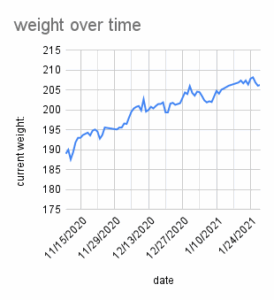
I did this again in late 2021:
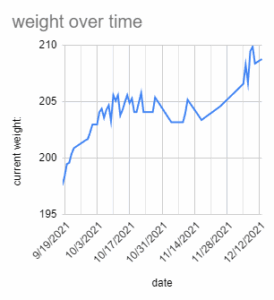
And again in late 2023:
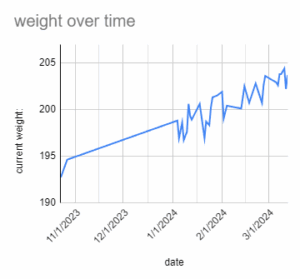
My disappointment
In early 2025 I started training for a Muay Thai fight. For the first time in my life I had to lose some weight. I used my old method of entering numbers into an app every day, but with my 32-year-old metabolism and not a lot of fat to lose, it wasn’t so easy.
Just kidding, it was super easy. Human bodyweight is a solved problem. One day I really had a kind of indignant moment when I looked at the scale and saw exactly the number I was expecting. “That’s it? That’s losing weight?” Pick a calorie number, type the day’s food into the app, stay under the number, and then it just works perfectly?
“Yeah but you’re just one of those people who can lose weight easily.”
Yes but then gaining weight should be hard for me, but it’s not. What then, I’m just lucky and everything’s easy for me, while coincidentally I’m a nerd and way more anal about typing numbers into an app than the average person? When I meet a person for whom everything is easy, I ask them about their methods.
Which app? What numbers?
The app is MyFitnessPal. It has a huge open-source database of foods with nutrition info. The free version has everything you need. You enter what you eat and look at the total calories and reach your calorie goal each day.
That’s it; that’s what changes your bodyweight. To ensure your overall health, you can look at one more number: If you’re losing weight, look at protein intake—make sure you’re still getting enough. If you’re bulking, look at sugar intake—make sure it’s not too much. The app will give recommendations for all of this.
Feedback-control system
There’s a range of daily calories where you don’t know what’ll happen to your bodyweight. Why? The number you enter may be wrong: maybe the food company didn’t estimate the caloric value well; maybe you didn’t estimate the food quantity well. But importantly, these should be random errors, not systematic errors. Random errors go in either direction, so in the long run they mostly cancel each other out.
If we’re measuring the right thing but our measurements are imprecise, but not systematically biased in either direction, then we just need to use a margin of error. Between the calorie amount where you definitely gain weight, and the calorie amount where you definitely lose, there’s a range where the outcome is uncertain.
All that is to say, if you’re eating in a caloric surplus and not gaining weight, increase the surplus. If you’re eating in a caloric deficit and not losing, increase the deficit.
There is one other feedback-control system, an obvious one: if you’re at the weight you want to be, don’t bother tracking your food anymore. When I’m changing weight, I set a weight goal for each week, weigh myself each morning, and if I reached or passed the week’s goal, no tracking that day. Then I check my weight again the next morning, and so on.
Become a nutrition expert by accident
Do this method every day for two weeks, and even if you stop there, you’ll know a ton of new useful things forever. I gained more practical knowledge about nutrition from those first two weeks of tracking my food than from all the health and fitness articles I used to read.
You’ll gain intuitions for the foods you often eat—what they are, chemically. My diet advice is to see things as they are. The carbon-chain molecules don’t care that they’re part of a substance with the word “diet” on the label, so why should you? You can just see substances for what they are. The databases of food info and the labeled packaging are the scientific tools with which you can remove the veil and see this part of the world as it is.
What are some examples? What did I learn?
- Shredded chicken breast is a weight-loss hack. High protein, low calorie. Make it in bulk, then put it on everything throughout the week. Season it with standard grill seasoning.
- Most vegetables are negligible in calories. Start dinner with a giant salad to fill your stomach before you eat real food.
- Shrimp has a really good protein-to-calorie ratio, especially considering how good shrimp tastes.
- Some cuts of red meat, like ribeye, are just too fatty to eat on a weight cut. I didn’t think of beef as being especially high-calorie (especially since it’s filling, so you eat less of it than other foods), but ribeye steaks are.
- Oils and nut butter are gasoline for humans: extremely calorie-dense. This is counterintuitive because oils don’t taste especially good.
- Liquid calories are too easy to eat. They don’t make you feel full, so they’re the first thing you should cut when reducing your calorie consumption. Orange juice is more of a blood-sugar-recovery drug for advanced athletes than a food.
- For gaining, use the liquid calorie thing to your advantage by drinking a protein shake at the end of every day. Put in whatever’s needed to meet your remaining calorie goal: peanut butter, coconut oil, oats, bananas. You can drink a 1000-calorie meal in 90 seconds.
I could take any one of those and make a “diet” out of it. The shredded-chicken-five-days-a-week diet. The big-salad-to-make-you-feel-full diet. Instead I’m telling you how to see. Learn how to see food, then direct your vision to your own refrigerator, and all the little hacks will present themselves.
See the code
The building of good intuitions takes you from a moralizing view of food to a plain analytical view. Food shouldn’t be a moral reality! Instead of, “This is a bad food, but I’ve been so good this week…” you just have numbers that tell you the chemical properties of the food: calories, protein, etc. Is the number 300 good or bad? Neither. It’s just an input you keep in balance with everything else, to control the output, which is your body composition.
All you see is code.


Pingback: My fight, 2025 - Patrick D. Farley